Sometimes, the harder you look, the less likely you are to find.
This is particularly true for rare wildlife. A reminder that no matter how smart we are with our shiny Landcruisers and our telephoto lenses, we're subject to someone else's rules in the wilderness.
If we see something, it will be when we least expect it.
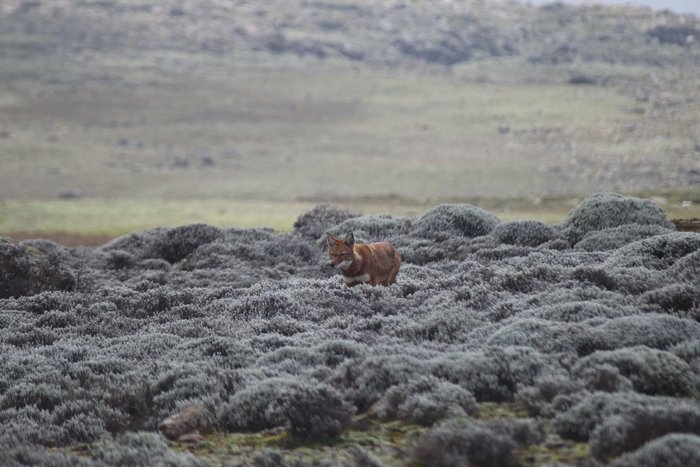
We were at close to 4000 metres, the end of a long dusty day's drive, crossing the Sanetti plateau in Bale Mountains National park in deepest south Ethiopia. I was thinking about a hot shower and dinner. A squall of icy rain clattered against the windscreen in the high altitude sunlight. I hadn't expected to feel cold in Africa.
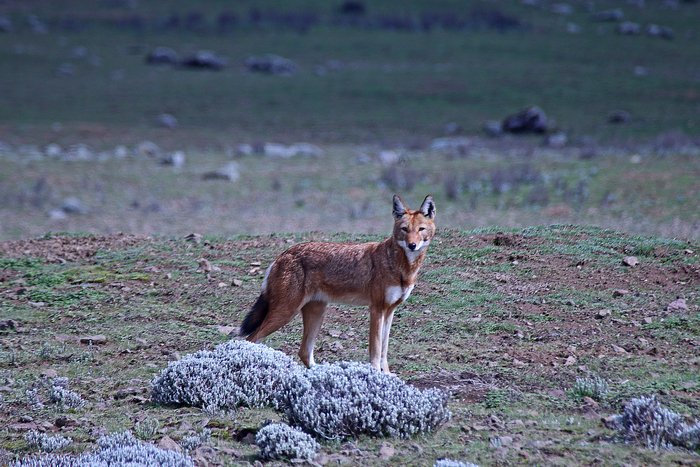
Then we saw them. Just 15 metres away, nose and tail tilted skywards; inquisitive, alert. An Ethiopian wolf. Our quest for this exceptionally rare canid wasn't supposed to start till the next day. He'd shown up early. We'd found what we’d come for, without even looking. How cool is that?
Little Red Riding Hood, Three Little Pigs, full moons and werewolves - wolves occupy a particular place in our collective psyche. They're bad. They are to be feared. I'd wondered how I'd feel if I did come face-to-muzzle with a real Ethiopian wolf. Would my blood run cold? Would some atavistic memory spur me to run screaming for my life?
In truth I was rooted to my seat not in fear, but in fascination. The unexpectedness of the siting meant I was there, just taking it in. I didn't even reach for my camera. Quickly, I realised. This chap wasn't the Baskervillesque beast that inhabited childhood nightmares. He was beautiful with a bright russet coat, attractive black stripes on his tail and nose. There was no getting away from it; my Ethiopian wolf looked rather… foxy.
We watched as he played, frolickingly alert. He looked full at us and then shook himself, just as a dog does. A halo of droplets flashed off his rain-logged coat in a sudden flurry of sunlight. It was the most beautiful thing.
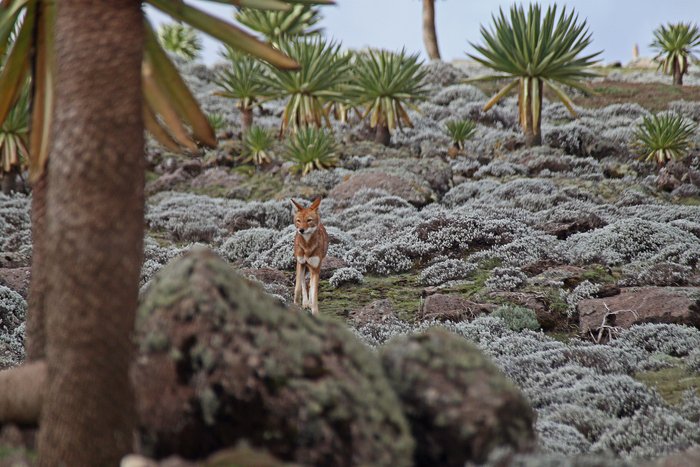
And then, he was gone as swiftly as he'd arrived. Spooked by our presence, he scampered into the rock and heather. But not before we'd managed to click off a heap of shots on our cameras. What an amazing start to our trip.
As far as lupine bragging rights go, the Ethiopian wolf is without doubt top dog. There are just 500 or so left. They're confined to a handful of sites at high altitude in north and south Ethiopia. We'd stopped just before entering the park to meet Edriss and Zegeye two of a small, dedicated team working for the Ethiopian Wolf Conservation Project to protect this highly endangered species.
"There are multiple threats to the wolves' future," Zegeye explained. "The biggest is contact with domestic dogs. Many carry rabies which is fatal for the wolves." The last outbreak in 1991 decimated the population, killing 70% in one fell swoop.
A similar outbreak could wipe them out. The team spend much of their time educating locals to control their dogs and vaccinating strays. But it feels like they're swimming against a vast tide. In a typical month they vaccinate upwards of 500 dogs.
"There's already evidence of dogs interbreeding with the wolves too," added Edriss. Perhaps the only thing that has ensured their survival is their habitat. They've adapted to live up on a high plateau that's cold and inhospitable where no locals are hardy enough to build homes.
As night began to fall, we continued our bumping journey to Bale Mountain Lodge where we were due to stay for the duration of our wolf hunt. We stopped on the lip of the plateau before plunging down the tight hairpins below and looked across a vast, craggy cloud-filled valley, backlit by the milky hues of the setting sun. We were literally on top of the world and in that rarified chilly atmosphere it felt fantastic to be alive; the threshold of an adventure.
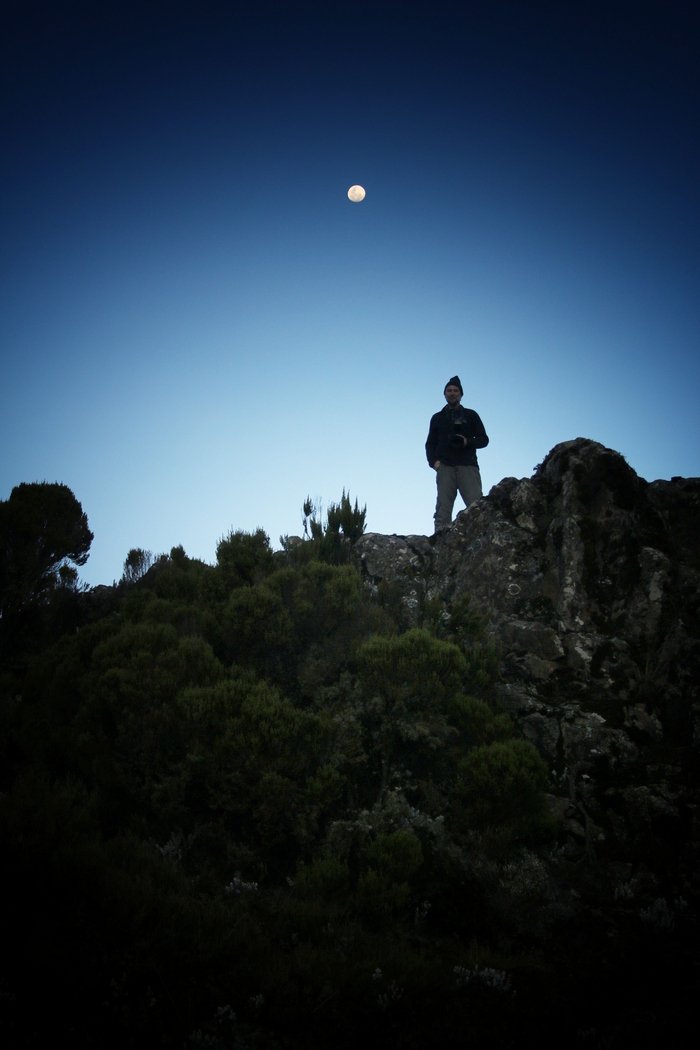
Until just a few months ago, the only way to see these wolves was to rough it under canvas, sleeping at the mercy of the chilly mountain elements, hiking serious mileage at breath-sapping altitude. Not anymore. Bale Mountain Lodge is the brainchild of retired Army Colonel Guy Levene and his wife Yvonne.
It's one of those once-in-a-lifetime projects that many people dream they might do, but few actually make happen. The lodge is miles from anywhere. Everything had to be trucked in: stones, steel, cement, generators, chairs, tables, king-sized beds, cookers and more. It was a task of epic proportions to create this comfortable bolthole from scratch. Huge luxury hotel chains do this, but a couple with just their savings and a heap of ambition? I was frankly in awe.
"We'd lived for years in Ethiopia and grown to love the place. We wanted to give something back and create something of lasting value," explained Yvonne over a couple of glasses of genuinely drinkable local wine that evening. "We came down here and camped in this spot and immediately felt this was the place."
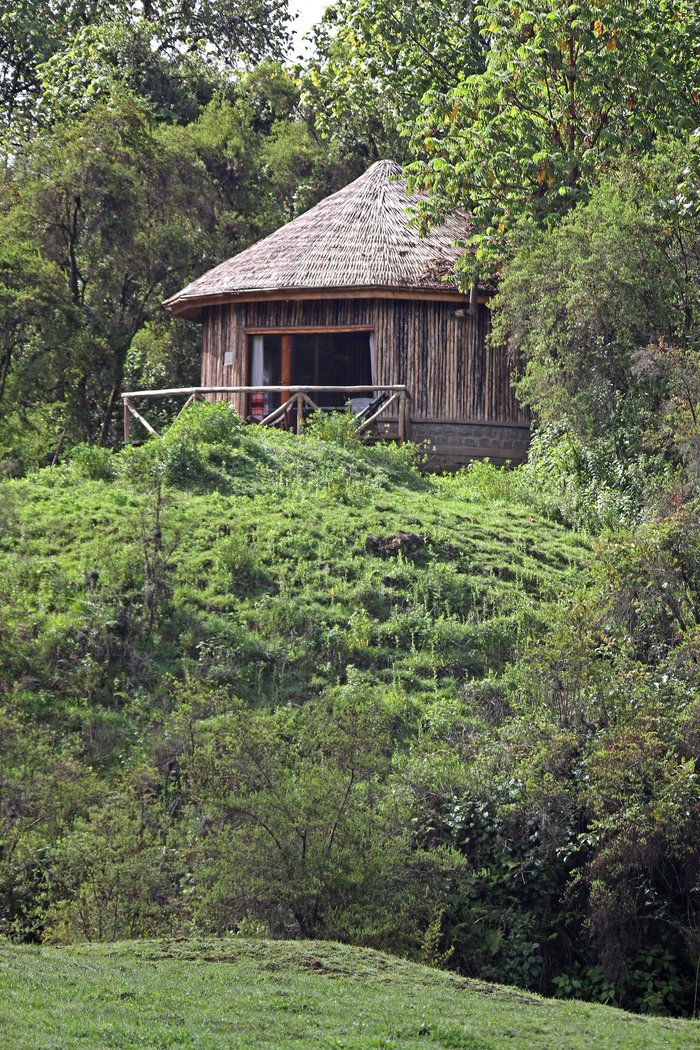
I realised why next morning when I saw it in daylight. The large thatched roundel that serves as restaurant and lounge and the clutch of cosy bungalows nearby nestle in the palm of a fist of mountains. An elephant-shaped peak rises in front, fringed with cloud forest at its base. A stream gurgles across a meadow in between. Shimmering in silent hot morning sunlight after an early-morning downpour, the place felt ethereal.
The area is teeming with unique species too. Guy and Yvonne have built a separate accommodation block for research teams because so many have projects here. We coincided with scientists from Kew Gardens researching wild coffee plants, a few weeks previously a team from Munich university had discovered 22 new species of moths and butterflies, in a study period lasting just 10 days. New species are being found on an almost weekly basis.
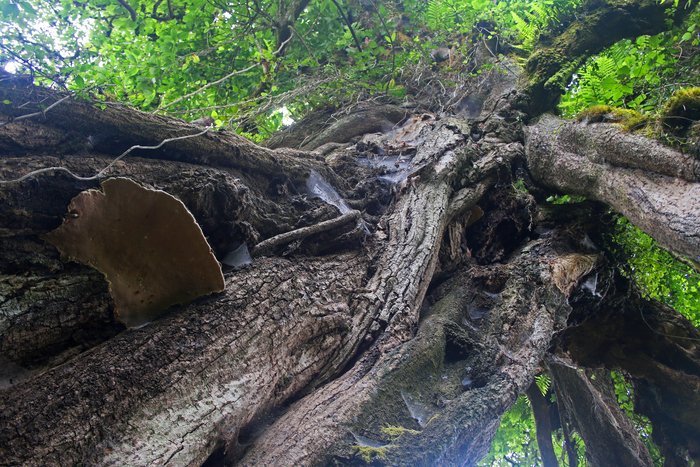
We spent our first morning exploring the cloud forest with the lodge's naturalist James Ndung'u. We wound our way between eons-old hardwood trees with buttress-roots that made them look like the ruins of cathedrals. James reeled off figures. "There are 280 bird species, 82 mammal species and some 1600 different plants," he explained. "The forest continues for 1200 square kilometres, so imagine what we've yet to find." A turaco bird flashed overhead its wingtips fiery red.
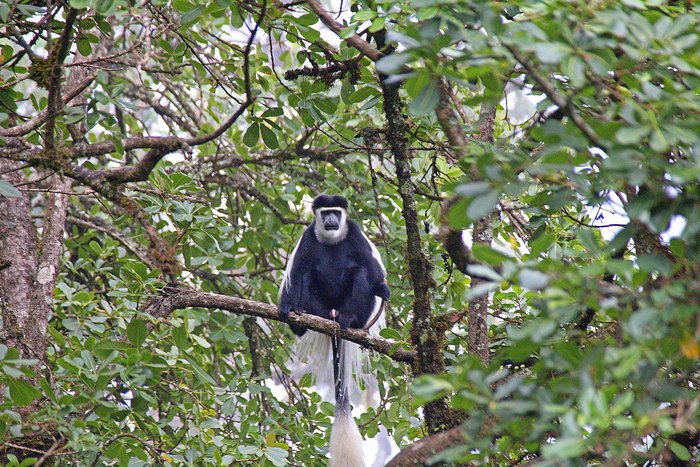
Minutes later James brought us to a hushed standstill. He'd spotted a family of colubus monkeys, high above. They clattered through the trees, a blur of black and white fur. Soon after, we caught glimpses of bale monkeys - a species unique to here. We crashed and sweated our way through a tangled forest of bamboo, trying to get closer, but to no avail.
Returning to the lodge we walked in the opposite direction and saw platoons of baboons on an open field, a solitary rare bushpig grazed unconcernedly alongside a group of local cattle. Noisy hornbills honked and flapped above us. There was wildlife everywhere.
That afternoon we set to with our wolf hunt. The climb back up to the Sanetti plateau took about 45 minutes. As we climbed, cultivated land with huts and cows gave way to moody giant heather forests. Bushbuck skidded away from us; remarkably, two jackals dived into the undergrowth as we approached a bend. “You normally only see them at night," James said.
The trees were now cloaked in dark green mossy coats, thick creepers hung from their bows. Hairpin followed hairpin as the Landcruiser ground on up. Lower level heather announced our arrival at higher altitude. Moments later we were enveloped in cloud and when we burst through it at the top the scenery had changed again - vast plain with steep mountains on either side, covered in a carpet of scrubby white everlasting flower bushes.
James pointed out stack’s hares scared witless, fleeing from us as we approached and two chestnut nibbed franklins – grouse-like birds. Both are only found here. I learned a new word – endemic. It means that a species of wildlife is found nowhere else. This habitat is exceptionally unusual and that means a particularly high occurrence of endemicity. "Given the extreme conditions, some plants and creatures are smaller than usual, but there are also examples of gigantism," explained James.
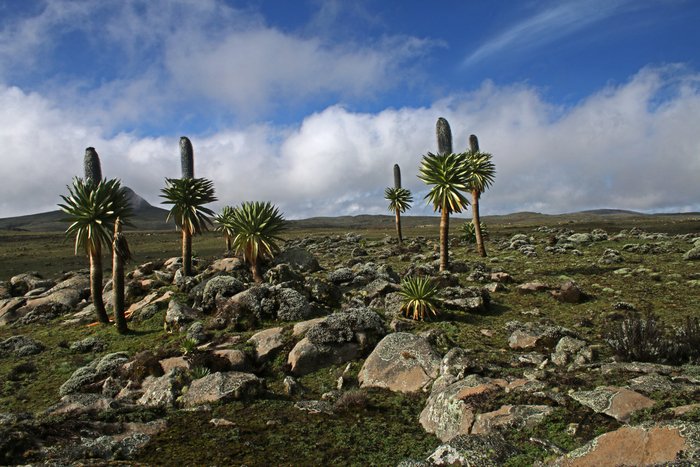
So along with the tiny everlasting flower bushes we also see bursts of giant lobelia - spiky cacti atop stalks taller than me whose cells have evolved to freeze and then thaw without suffering damage. Rodent life is particularly plentiful, including the giant mole rat - again unusually large - and a favourite prey for the wolves.
But would we see them? Sure I was enjoying James' descriptions of the plateau's unique facets, but what about wolves? The tight confines of the plateau, combined with an abundance of small mammals for the wolves to eat, means they live in high levels of concentration here despite their small number. But today the clouds descend and the high road across the plateau becomes shrouded in gloom. We roll on slowly, trying to see through the murk. After an hour we’ve seen nothing. I ask for a pee break.
And, of course, that's when I see him. “Wolf!” I cry, dangerously close to falling over in my state of undress. He lopes across the moorland and drops down towards a small lake. He wades across. I’m fascinated to see him glance at a small goose floating precariously close to him, but he ignores it and continues towards us.
We wait, hardly daring to breathe, fingers itchy on our camera triggers. But then he spies us and lets out a series of high pitched yips. “That’s his danger signal," says James as the wolf splashes back across the lake. So near and now already, so far.
Continuing our quest next day, we meet two men walking on the road. Sultan and Gobe work for the Ethiopian Wolf Conservation Programme's monitoring team. The monitors spend seven-day stretches up her living in a basic mud hut, cooking on an open fire by the light of a dim solar powered bulb.
It's another cloudy day and we end up huddled around their fire drinking hot, sugary tea and sheltering from squally rain. "I miss my wife and family, but I love being out here," says Sultan.
He shows us a tablet computer. A bespoke app on it allows him to record every wolf siting -the location using GPS, the sex of the wolf, the pack it's from, the habitat he finds it in and even its posture. It's a crucial part of the conservation programme. It's remarkable to see a first world plaything being put to such use in these third world conditions.
Over the next couple of days we are rewarded with quite frequent sightings. The wolves almost bounce along on their toes. I can’t get enough of watching them. They are attractive, noble creatures. And it’s just us, on this wide plateau of lichen-covered rocks, sparkling pools and tiny bright flowers. Just us and the wolves.
But they're always at a distance. No matter how hard we try, we can't get within about 20 metres before the wolves spot us and dash away. So we pack to leave. There's a long day's drive back to Addis ahead. Mixed with a glow of satisfaction at seeing these rare creatures, there's a hint of disappointment. There shouldn't be. We've managed around 30 sightings. But we've not got those top shots of a wolf staring straight down the lens.
Maybe we'd been looking too hard? We're halfway across the plateau, talking about our plans for the evening. Then we see him. A lone wolf - much closer. We inch forward in low gear, expecting him to dash off. But this one is oddly unworried by our presence. He sniffs around the heather. Focussed on tracking down prey, he ignores us.
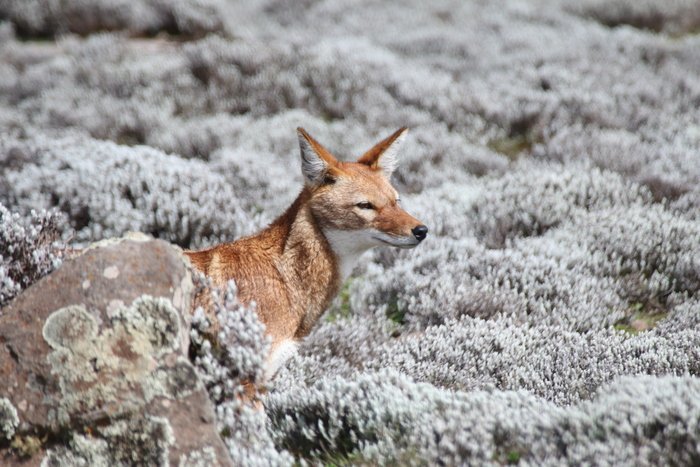
He's successful too. I watch, fascinated, as he pounces on a grass rat. A couple of gulps and he has swallowed it whole. We get out of the car. Still he doesn't run away. We take heaps of photos. Mission totally accomplished - just when we least expected it.